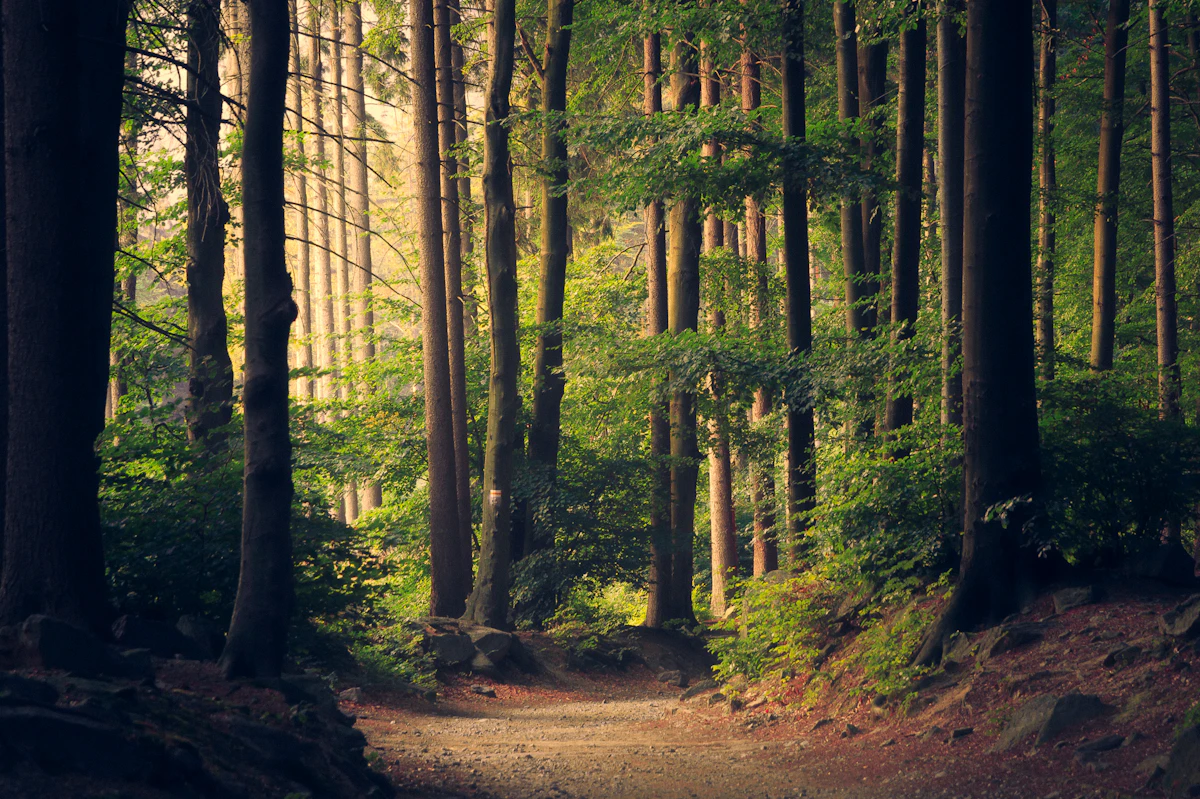
A forest can look magical in person and messy in a photograph. The problem is usually contrast: bright patches of sky and sunlit leaves sit next to very dark trunks and shadowed ground, and the camera struggles to hold both. The solution is not to wait for perfectly even light, which rarely happens in woodland, but to work with the contrast deliberately, choosing a small, clear subject inside the larger forest.
Look for one shaft of light, not the whole forest
Early morning and late afternoon often send shafts of light between trunks, and those shafts make natural leading lines. Position yourself so the light falls on a single tree, a path, or a patch of ferns, and let the rest of the scene fall darker. That one bright area gives the eye somewhere to rest. If the whole frame is equally bright, the photo feels busy; if one area is brighter, the forest gains depth and calm. A path, a bend in a track, or a fallen log can serve as a foreground that leads into that light.
Expose for the highlights and check the shadows
Exposing for the brightest leaves keeps them from turning white and featureless, and shadows can usually be lifted later, especially if you shoot in raw. Watch for blown-out sky visible through the canopy, which is often the brightest part of the frame; moving a few steps can hide it behind a trunk. A tripod helps when light is low, because it lets you use a slower shutter speed without blur, but it is not essential if you raise the ISO a little and accept a small amount of grain. related guide covers the same idea in mountain sunrise, where the brightest sky also needs care.
Simplify the frame before you shoot
Forests reward simplification. Move left or right to remove a bright stump, a sign, or a distracting branch at the edge of the frame, and try a vertical composition that follows the trunks upward. Photograph in overcast weather too: cloud softens the light, reduces harsh patches, and brings out green tones that harsh sun can bleach. After the shoot, compare frames and notice which ones kept a single clear subject; that comparison teaches you faster than any rule about forest photography. another guide in this category shows how tide and golden hour shape a coastal scene in a similar way.
Take a short note of the time, the weather, and the direction of light for each woodland you visit. Forests change with the seasons, and a note from a previous visit turns a good location into one you can return to with a plan.